
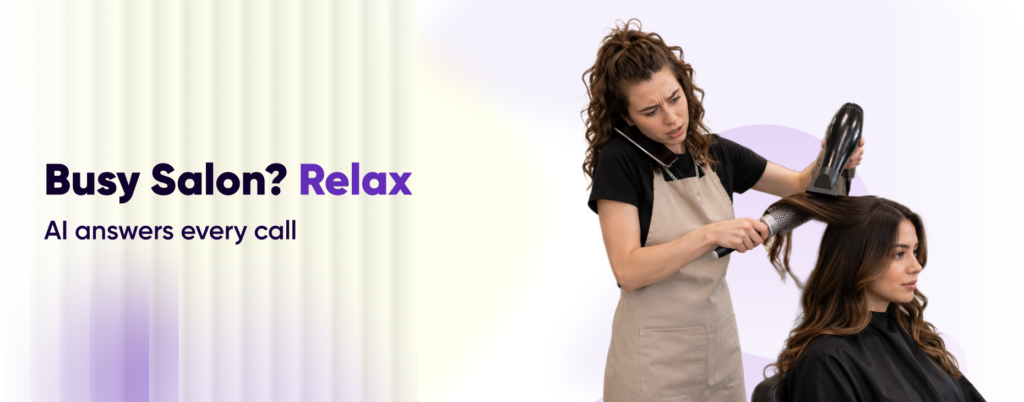
An AI call agent helps salons manage peak-hour calls by answering every customer immediately, booking appointments automatically, and reducing interruptions for salon staff. Instead of placing callers on hold or missing bookings, salons can stay responsive even during their busiest hours.
If you run a salon, you already know what peak hours feel like. Saturday mornings. Thursday evenings. The week before a holiday. Every chair is full, every stylist is mid-service, and the phone won’t stop ringing. Someone has to choose between finishing a client’s color and answering a call that might be a new booking or might be a cancellation that needs immediate rebooking to fill the slot.
This is the moment most salons lose money without realizing it. A missed call during a quiet afternoon is a minor inconvenience. A missed call during peak hours is a lost client, often a client who simply calls the next salon on their list.
In this blog, you’ll learn exactly why peak-hour calls slip through the cracks, what an AI call agent actually does differently, which tasks it can take off your frontdesk’s plate, and how to know if your salon is at the point where automation makes sense. We’ll also walk through real scenarios a packed Saturday, a Thursday evening rush, and holiday booking season so you can see how this plays out in a real shop, not just in theory.

Why do salons miss the most calls during peak hours?
Salons miss the most calls during peak hours because every team member is already occupied with a client, and answering the phone means stopping a service or leaving the frontdesk unattended. This isn’t a staffing failure it’s a structural one. There’s only one phone and one receptionist, but five things happening at once.
Think about what’s actually going on at 11 a.m. on a Saturday. Your receptionist is checking out a client, taking payment, and rebooking their next appointment all while two more clients are waiting to check in. The phone rings. There’s no one free to grab it without making someone in the salon wait.
A few patterns show up again and again:
- The frontdesk doubles as checkout, scheduling, and retail sales, so the phone is the fourth job, not the first.
- Stylists can’t step away from a color treatment or a chemical service to take a call.
- Multiple calls can arrive within the same minute, and a single receptionist can only handle one at a time.
- Calls that do get answered are often rushed, increasing the chance of a booking mistake.
The result is a pattern of missed calls that clusters almost entirely around the hours when new business is most likely to call in. If you’ve noticed your voicemail filling up right when the salon is busiest, that’s not a coincidence it’s the predictable outcome of one phone line and a fully booked floor. This is one of the clearest warning signs your salon needs Frontdesk AI.
How does an AI call agent keep every client call answered?
An AI call agent keeps every client call answered by handling multiple calls at the same time, regardless of how busy the salon floor is. It doesn’t put callers on hold or send them to voicemail it picks up immediately, every time, whether that’s the first call of the day or the fifth call in the same minute.
This is the core difference between a human receptionist and an AI call agent: capacity. A person can only be on one call at a time. An AI call agent can be on five calls at once without any of them feeling rushed or deprioritized.
Picture a Thursday evening rush. Three stylists are running back-to-back appointments, the receptionist is helping a walk-in, and four calls come in within ten minutes a reschedule, a new client asking about pricing, an existing client confirming tomorrow’s appointment, and someone wanting to know if you take walk-ins. With a single frontdesk line, at least two or three of those calls go unanswered. With an AI call agent, every one of them gets handled in real time, and your staff stays focused on the clients physically in the salon.
Which peak-hour tasks should an AI call agent automate?
An AI call agent should automate the repetitive, time-sensitive tasks that pile up during busy hours: bookings, rescheduling, FAQs, appointment confirmations, and service inquiries. These are high-volume, low-complexity interactions exactly the kind of work that benefits most from instant, consistent handling.
Here’s what that looks like in practice:
- Bookings – A new client calls wanting a balayage appointment. The AI checks real-time availability and books the slot without anyone at the frontdesk touching the calendar.
- Rescheduling – A client needs to push their appointment from 2 p.m. to 4 p.m. The AI finds the new opening and confirms it instantly.
- FAQs – Questions like “Are you open on Sundays?” or “Do you do men’s cuts?” get answered immediately instead of sitting in a voicemail queue.
- Appointment confirmations – Automated reminder calls or confirmations reduce no-shows without anyone manually dialing through a client list.
- Service inquiries – Pricing questions, service duration, and stylist availability get answered without pulling a team member off the floor.
None of this requires judgment calls or sensitive handling it’s the kind of structured, repeatable work that runs the same way every time. For a broader look at what this kind of system can take on beyond the phone, see this overview of AI automation for salons.
How do busy stylists benefit when AI answers calls?
Busy stylists benefit when AI answers calls because they’re no longer interrupted mid-service to deal with scheduling questions, and they’re not relied upon to remember details from a rushed phone conversation. The result is fewer disruptions, more focused service time, and a better experience for the client actually in the chair.
There’s a ripple effect here that’s easy to underestimate. When a stylist gets pulled away even for thirty seconds to answer the phone or relay a message, the client in front of them notices. It signals that the salon is stretched thin. When calls are handled entirely outside the stylist’s workflow, that interruption disappears.
This shows up in a few concrete ways:
- Stylists stay focused on the service in front of them, which tends to improve quality and consistency.
- Frontdesk staff aren’t pulled in three directions during checkout, intake, and phone duties simultaneously.
- Clients in the salon get full attention instead of overhearing a phone conversation mid-appointment.
- Team stress drops because peak hours stop feeling like triage.
What happens when clients can’t reach your salon immediately?
When clients can’t reach your salon immediately, the most common outcome is that they call a competitor instead. Most callers don’t leave a voicemail and wait they hang up and dial the next salon on their list. That single missed call often represents lost revenue that never shows up on a missed-call report, because the client never tries again.
This is the part of the equation that’s hardest to measure but most costly. A missed call doesn’t just mean one lost booking it can mean losing that client permanently if a competitor books them first and does a good job. First impressions in this industry are largely formed by how quickly and smoothly a salon handles that initial phone call.
The compounding effects look like this:
- Lost revenue Each unanswered call during peak hours is a potential booking that goes elsewhere.
- Competitor bookings The client doesn’t wait; they search and call the next available salon.
- Customer frustration Even loyal clients get frustrated by repeated voicemail or no answer, especially for time-sensitive needs like a last-minute event.
Salons that track this closely often find that their busiest hours the ones generating the most revenue per hour are also the hours with the highest call abandonment rate. That’s a costly pattern hiding in plain sight.
Can an AI call agent improve peak-hour booking accuracy?
Yes, an AI call agent can improve peak-hour booking accuracy by following a consistent process every time, regardless of how chaotic the floor is. It pulls from real-time calendar data, double-checks service duration and stylist availability, and doesn’t make the kind of rushed mistakes that happen when a receptionist is juggling five things at once.
Booking errors during peak hours are rarely about carelessness they’re about cognitive overload. A receptionist trying to book a 90-minute color service while also checking out a client and answering a question from a stylist is far more likely to double-book a chair or misjudge service timing than during a quiet Tuesday morning.
An AI call agent doesn’t experience that kind of split attention. It checks availability the same way every time, applies the same service-duration logic every time, and confirms details with the caller before finalizing. The result tends to be:
- Fewer double-bookings during high-volume hours
- More accurate service-duration estimates
- Consistent data entry into the scheduling system
Salons that have made this shift often see the difference reflected directly in their numbers you can read more in this breakdown of real ROI from AI receptionists.
How do multi-location salons manage high call volumes?
Multi-location salons manage high call volumes by centralizing call handling and routing each call to the correct location automatically. Instead of each location managing its own frontdesk bottleneck independently, calls are answered consistently across every branch and directed based on the caller’s request.
This matters more as a salon group grows. A single-location shop has one peak-hour problem. A five-location group has five simultaneous peak-hour problems, often at different times depending on each location’s client base and staffing. During peak hours, an AI voice agent for salons picks up every call instead of sending the fifth caller to voicemail.
Centralized call handling solves a few specific pain points for multi-location groups:
- Centralized call handling – One system manages call volume across all locations instead of each frontdesk operating independently.
- Location routing – A caller asking about the downtown location gets routed and booked into that specific calendar, not a generic one.
- Consistent brand experience – Every location answers the phone with the same level of responsiveness, regardless of how busy that particular branch is.
For salon groups, this also means leadership gets visibility into call patterns across every location, rather than relying on individual frontdesk staff to report missed-call trends.
What should salons expect during their busiest business hours?
Salons should expect predictable call surges during specific windows: lunch hours, weekday evenings, and weekends. These patterns repeat week after week, which means the call volume problem isn’t random it’s structural and largely predictable once you look at the data.
Most salons see a consistent rhythm:
- Lunch hours – Clients calling on their break to book or reschedule around their own work day.
- Evenings – After-work calls from clients planning weekend appointments or last-minute touch-ups.
- Weekends – The highest call volume of the week, often overlapping with the highest in-salon foot traffic.
- Holiday season – Booking demand spikes well beyond normal capacity, with many clients calling for the first time in months.
Knowing these patterns matters because it tells you exactly when your current setup is most likely to fail. If your busiest hours are also your highest missed-call hours, that’s not a staffing gap you can simply schedule around it’s a structural mismatch between call volume and available hands.
How can salon owners measure the success of an AI call agent?
Salon owners can measure the success of an AI call agent using four core KPIs: answer rate, missed calls, booking rate, and average response time. These numbers tell you, in concrete terms, whether the system is actually solving the problem it was meant to solve.
- Answer rate – What percentage of incoming calls are picked up, especially during peak windows.
- Missed calls – The raw number of calls that go unanswered, tracked specifically during your busiest hours.
- Booking rate – How many of those answered calls convert into a confirmed appointment.
- Average response time – How quickly a caller is greeted and helped, rather than placed on hold.
Tracking these before and after introducing an AI call agent gives you a clear before-and-after picture rather than a vague sense that “things feel better.” Most salons find the most dramatic shift specifically in their peak-hour answer rate, since that’s the window where the old system was failing hardest.
What mistakes should salons avoid during peak-hour automation?
Salons should avoid three common mistakes when automating peak-hour calls: poor call flows, no customization, and no escalation path. Each of these undermines the entire point of automation handling calls well, not just handling them fast.
- Poor call flows – If the AI’s script is generic or doesn’t reflect how your salon actually operates, callers get frustrated instead of helped.
- No customization – Every salon has its own services, pricing structure, and booking rules. A one-size-fits-all setup will mishandle calls that don’t fit the default template.
- No escalation – Not every call should be fully automated. Upset clients, complex requests, or urgent issues need a clear path to reach a salon receptionist.
The goal isn’t to remove humans from the process entirely it’s to make sure the AI handles the high-volume, repetitive work while still recognizing when a call needs a human touch.
When is the right time to introduce an AI call agent?
The right time to introduce an AI call agent is when missed calls are becoming a regular pattern rather than an occasional issue, especially during predictable peak hours. If you’re seeing the same call-volume problem week after week, that’s a clear buying signal not a temporary staffing hiccup.
A few signs it’s time to make the move:
- Missed calls are concentrated heavily in specific, predictable hours.
- Your frontdesk staff regularly mentions feeling overwhelmed during the same windows each week.
- You’re growing new chairs, new stylists, or new locations and call volume is rising faster than staffing can keep up.
- Clients have mentioned difficulty reaching you, even casually.
If any of these sound familiar, it’s worth understanding the investment involved before making a decision this guide on AI receptionist pricing for salons breaks down what to expect.
How can busy salons stay responsive without hiring more staff?
Busy salons can stay responsive without hiring more staff by using an AI call agent to absorb peak-hour call volume that would otherwise require an additional frontdesk hire. This is fundamentally a question of operational efficiency: solving a capacity problem with a system rather than with payroll.
Hiring another receptionist solves the problem only during the hours that person is scheduled, and it adds a fixed cost that doesn’t flex with demand. An AI call agent scales with call volume automatically it handles one call or ten calls with the same level of responsiveness, whether it’s a slow Tuesday or a packed Saturday before a holiday.
The outcome salons consistently report is straightforward: fewer missed calls, more consistent bookings, and a frontdesk team that isn’t stretched across five tasks at once. That’s the practical answer to the question this entire article is built around busy salons don’t need another person to answer every call. They need a system that never misses one.
If you’re ready to put this into practice, this walkthrough on setting up an AI receptionist for your salon covers exactly what the process looks like.
Frequently Asked Questions
Yes. Unlike a single receptionist, an AI call agent can handle multiple simultaneous calls without putting any of them on hold or sending them to voicemail.
Yes, most AI call agents are available around the clock, allowing clients to book or ask questions even when the salon is closed.
Yes. Call flows can be tailored to match specific services, pricing structures, booking rules, and the salon’s preferred tone of voice.
Yes. A properly configured AI call agent can recognize urgent or complex calls and route them to a staff member instead of handling them automatically.
In most cases, yes. AI call agents are typically set up to work with a salon’s current phone number, so there’s no need to change the number clients already know.
 BookingBee lets our clients book appointments anytime, even after hours, with every booking going straight into our calendar. Last month alone, 300+ after-hours calls created $6,000 in value. The team is fast, reliable, and highly responsive. BookingBee has been a game-changer for our salon’s operations and customer experience.

See how an AI call agent fits your salon's schedule
Book a short walkthrough to see exactly how call handling, booking accuracy, and peak-hour coverage would work for your specific salon no commitment required.
Book A DemoRelated Posts
How Salons Generated $1M+ With One Move

AI Receptionist for Medical and Wellness: Complete Guide
How To Train An AI receptionist On Your Salon’s Specific Services
How to Fill Your Salon’s Calendar: Waitlists, Cancellation Recovery
How to Increase Salon Revenue: 10 Strategies That Actually Work in 2026
Latest Blogs
Best practice
September 2, 2026How Salons Generated $1M+ With One Move
Every salon owner is chasing growth. New ads. New offers. New retail shelf. New social posts at midnight. But the salons crossing seven figures didn’t do more. They fixed one…
Best practice
August 19, 2026AI Receptionist for Medical and Wellness: Complete Guide
An AI receptionist for medical and wellness practices is a 24/7 conversational voice and messaging tool that automates routine front-desk tasks like booking appointments, answering FAQs, and routing urgent calls.…
Best practice
July 11, 2026How To Train An AI receptionist On Your Salon’s Specific Services
Every salon runs differently. Your pricing, your stylists’ specialties, your cancellation rules none of that is “one size fits all.” So before you hand off your phone lines to automation,…