
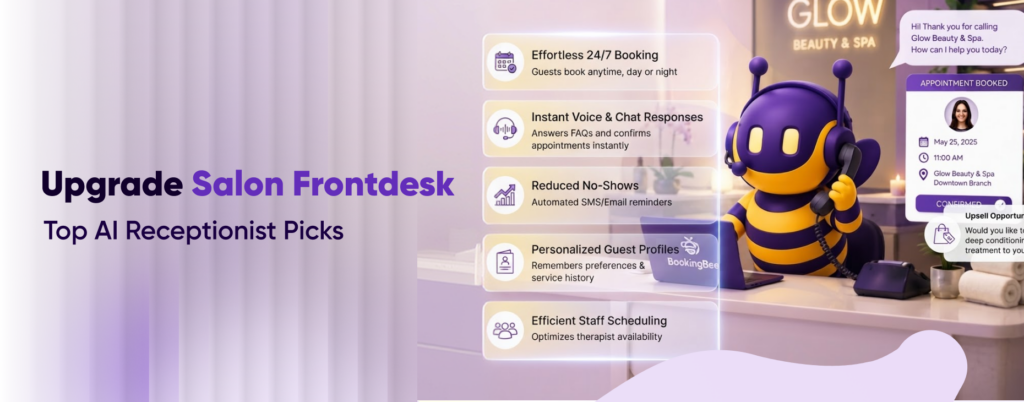
Missed calls. Overbooked front desks. Clients who text at 9 PM and give up when nobody replies. If any of that sounds familiar, you already know why salon owners everywhere are turning to AI. The AI receptionist for beauty salons doesn’t just answer the phone it books the appointment, reminds the client to show up, and quietly brings back the ones who drifted away, all without adding a single hour to your front desk staff’s day.
This blog breaks down the 10 best AI receptionist tools for salons and spas in 2026, how we evaluated them, what actually makes one worth paying for, and how to get one running in your salon without disrupting the systems you already use.

Key Takeaways
- An AI receptionist for beauty salons answers calls, texts, and social DMs 24/7, books real appointments directly into your calendar, and follows up automatically no human front desk required for the basics.
- BookingBee.ai leads this list because it goes beyond phone and SMS: it covers Instagram, Facebook, web chat, reminder calls, and outbound win-back calls from one system, so bookings don’t leak out through channels you’re not watching.
- Not every tool fits every salon. Solo stylists, multi-location chains, and med spas each need different feature sets we break down the best fit by salon type further down.
- The features that matter most are salon-specific service intelligence, multi-channel coverage, existing salon software integration, and no-show reduction not flashy chatbot demos.
- Pricing varies widely, from roughly $25/month for basic call answering up to $400+/month for human-backed receptionist services see the full pricing comparison further down.
- Setting up an AI receptionist usually takes under a week when your booking software (Meevo, Phorest, Mindbody, Boulevard, Square, Booker, or SetMore) is already in place.
How We Tested the Best AI Receptionists for Beauty Salons
We didn’t rank these tools off marketing pages. Each platform on this list was evaluated against the same set of real front-desk scenarios a beauty salon runs into every week:
- Booking accuracy for salon-specific services Could the AI correctly book a balayage appointment that needs extra chair time, versus a quick root touch-up, without double-booking a stylist?
- Channel coverage Does it only answer phone calls, or does it also catch texts, Instagram DMs, Facebook messages, and website chat, where a growing share of beauty clients actually try to book?
- No-show and re-engagement handling Does the tool just send a generic reminder, or does it actively call clients who’ve gone quiet and try to get them rebooked?
- Integration depth How cleanly does it sync with the calendar and existing salon systems already run on, without creating double entries or sync delays?
- Tone and realism Does the AI sound like a trained receptionist, or like an obvious bot reading a script?
- Pricing transparency Is the cost structure clear per stylist or per location, or buried behind a “book a call to find out” wall?
We weighted booking accuracy and channel coverage the heaviest, because a receptionist that only handles phone calls is solving less than half the problem for a modern beauty salon.
What Is an AI Receptionist for Beauty Salons?
An AI receptionist for beauty salons is software that handles the conversations your front desk would normally handle answering calls, replying to texts, booking and rescheduling appointments, sending reminders, and following up with clients using natural, human-like voice and messaging instead of a static form or a basic chatbot.
Unlike a generic virtual assistant, a salon-specific AI receptionist understands the actual vocabulary of the industry: service duration, add-ons, stylist specialties, and the rhythm of how beauty appointments get booked and rebooked. That’s the difference between a tool that merely answers and one that actually converts a missed call into a paid appointment.
What a Salon AI Receptionist Actually Does
Strip away the marketing language and a good AI receptionist is doing a handful of concrete jobs, all day, every day:
- Answering every inbound call so no client hits voicemail during a busy Saturday.
- Booking and rescheduling appointments directly into your live calendar, in real time.
- Sending appointment reminders by voice or text to cut down no-shows.
- Capturing after-hours leads when a prospective client calls at 8 PM and your doors are closed.
- Reaching out to lapsed clients who haven’t booked in weeks, with a friendly nudge to come back.
- Collecting feedback after a visit so you can catch service issues before they turn into bad reviews.
- Syncing with your existing software so nothing has to be entered twice.
The best tools do all of this across more than just the phone which is exactly where most salons start losing bookings without realizing it.
How Does an AI Receptionist Work for Salons?
Under the hood, an AI receptionist for salons combines conversational voice and messaging AI with a direct connection to your booking calendar. When a client calls, texts, or messages, the AI:
- Understands the request recognizing the service, the preferred stylist, and the general time window the client wants, even if they phrase it casually (“can I get in for color sometime next week?”).
- Checks real-time availability against your actual calendar, not a static list, so it never offers a slot that’s already taken.
- Confirms and books the appointment, or offers the closest alternative if the exact time isn’t open.
- Logs the interaction in your CRM or existing salon software so your team has full visibility without lifting a finger.
- Follows up automatically reminders before the appointment, feedback requests after, and re-engagement outreach if the client goes quiet.
Because it’s connected live to your calendar and client history, it behaves less like a chatbot and more like a well-trained front desk employee who happens to never take a sick day.
The 10 Best AI Receptionists for Beauty Salons in 2026
1. BookingBee.ai The Smarter AI Receptionist Built for Salons & Spas
Your salon’s 24/7 front desk that never sleeps.
BookingBee.ai is a salon-specific AI receptionist built to handle communication, booking, and client engagement without needing a human on the other end. It holds natural, human-like conversations across voice and SMS, so salons and med spas can manage bookings, reschedules, and client questions even outside business hours.
What sets BookingBee apart from most of the tools on this list is that it doesn’t stop at phone and text. Here’s where it actually plugs the leaks other AI receptionists leave open:
- Instagram and Facebook message handling When a client DMs your salon on Instagram or Facebook asking about availability, BookingBee responds and sends them a direct booking link on the spot, instead of leaving that message sitting unread until someone on your team notices it.
- Web chat booking Clients browsing your website can book straight through chat, no phone call needed.
- Automated reminder calls Every upcoming appointment gets a voice or SMS reminder, cutting down no-shows without anyone on staff having to make the call.
- Outbound win-back calls If a client hasn’t been in for a while, BookingBee proactively reaches out with a re-engagement call to get them back on the books, instead of just hoping they remember to rebook on their own.
- One system, every channel Phone, SMS, Instagram, Facebook, and web chat all route through the same AI receptionist, so a client can book wherever they’re already talking to you.
Additional key features:
- AI Voice Receptionist Answers every call professionally, 24/7, even when the front desk is closed.
- Salon-specific intelligence Accurately books services like balayage, root touch-ups, facials, and keratin treatments, instead of treating every appointment as identical.
- Smart reminders Timely voice or SMS reminders that measurably reduce no-shows.
- After-hours lead capture Inquiries and bookings get handled even when your staff is off the clock.
- Client retention calls If a client hasn’t visited in 30-45 days, BookingBee automatically triggers a re-engagement call to invite them back.
- Feedback collection A quick voice or SMS follow-up after each visit, so you catch satisfaction issues in real time.
- Software sync Connects with the salon software you’re already running, so nothing needs to be rebuilt from scratch.
Why it stands out: Most competitors on this list answer calls or texts. BookingBee answers calls, texts, Instagram, Facebook, and web chat which matters, because every one of those channels is a place a client can try to book, and every one you’re not covering is revenue quietly walking out the door. The point isn’t just picking up the phone faster; it’s making sure you stop losing bookings across every single platform your clients actually use.
Pricing: $99/month for up to 8 stylists, $299/month for up to 16, and $499/month for unlimited stylists. Two tiers are available: Premier (inbound calls, outbound reminders, omni-channel messaging) and Elite (adds outbound client retrieval calls, the Central Concierge Brain, and custom voice cloning).
2. Qlient.ai
Qlient.ai focuses on realism. It handles nuanced conversations, books and reschedules appointments, and summarizes calls automatically.
Why it stands out:
- Hyper-realistic voice AI that simulates human tone and emotion
- Automatically updates calendars and generates call summaries
- Built specifically for spas and salons
- Well-suited to businesses with high call volume
If your priority is a voice AI that sounds indistinguishable from a real person, Qlient is worth a demo.
Pricing: Basic plan runs $299/month for 60 calls, Professional is $599/month for 150 calls (both drop slightly on annual billing), plus a custom Enterprise tier for higher volume.
3. MyAIFrontDesk
Built for hairstylists and salon owners, My AI Front Desk answers phones and texts around the clock, understands service-specific questions, and books appointments in real time.
Standout features:
- Combined phone and text AI front desk
- Instant booking with real-time calendar updates
- Human-like responses to client questions
- Reduces the need for full-time front desk staff
A solid option for small salons that want reliable, always-on coverage without a big price tag.
Pricing: A free plan is available with limited usage (around 20 voice minutes). The main paid plan runs $99/month ($79/month billed annually) with 200 voice minutes included alongside chat, SMS, CRM, and automations; extra voice runs about $0.25/minute past that. Custom Partner/Enterprise pricing is available for agencies and higher volume.
4. Smith.ai AI
Smith.ai pairs an AI receptionist with live human agents for when conversations get complicated. It’s built for salons that want white-glove service without dropping a single lead.
Key benefits:
- 24/7 answering through AI plus a human team
- Call summaries with CRM integration
- Appointment booking with live calendar sync
- Multilingual and HIPAA-compliant support
A strong fit if your salon serves premium or sensitive clientele that expects a human option nearby.
Pricing: The AI Receptionist line starts at $95/month for roughly 50 calls (with a free tier covering 25 calls/month). The human-staffed Virtual Receptionist plans start considerably higher, from about $292.50/month for 30 calls, with overage running $9.75–$11.50 per additional call.
5. TalkForceAI
TalkForceAI engages clients in friendly, fluent conversation while booking, confirming, and managing appointments casual in tone, but efficient underneath.
Highlights:
- Custom-branded AI chatbot
- Books appointments via website or mobile
- Supports multiple salon locations
- Sends directions, follow-ups, and reminders
Good for salons that want their AI to match a specific brand personality.
Pricing: Not publicly listed TalkForceAI uses sales-led pricing, with every plan routed through a contact form. Reported real-world costs typically land between $50–$100/month depending on configuration; request a quote for an exact number.
6. UpFirst.ai
UpFirst.ai is a straightforward AI receptionist that captures every lead, answers common questions, and books clients without depending on staff availability.
Why it works:
- Voice-based virtual receptionist
- Custom scripts per salon type
- Answers, qualifies, and books clients 24/7
- Priced within reach for solo stylists and small teams
A no-frills option for salons that just want fewer missed calls.
Pricing: Starter is $24.95/month for 30 calls, Premium is $59.95/month for 90 calls, Pro is $159.95/month for 300 calls, and Scale is a flat $299/month for 600 calls, with a negotiated Custom tier above that. Billing is per call, not per minute, and spam calls or calls under 15 seconds don’t count against the plan.
7. MySalonDesk
MySalonDesk blends human virtual receptionists with AI tools, offering phone, text, and email support built specifically for salons, spas, and med spas.
What makes it different:
- U.S.-based receptionists trained in salon operations
- Inbound call, chat, and email handling
- CRM updates and rebooking reminders
- Suited to high-touch service clients
Think of it as an upscale front desk without the full-time overhead.
Pricing: Reception plans are billed per call rather than per minute and start at roughly $400/month, reflecting the fact that you’re getting US-based human receptionists rather than pure AI. Larger salons and med spas can request custom high-volume or Enterprise pricing.
8. Automated Salon
AutomatedSalon handles calls, texts, and chats end to end, helping salons convert more leads without letting a single message go unanswered.
Automation strengths:
- Real-time appointment booking
- Multi-channel coverage across chat, voice, and SMS
- Salon-specific booking scripts
- Reduces no-shows and boosts rebooking
Built for teams that want full automation with minimal setup effort.
Pricing: Not publicly listed. AutomatedSalon sells through a consultation/demo process rather than a published rate card, so you’ll need to talk to their team for a quote based on your salon’s call and message volume.
9. AIAnsweringService.io
Not salon-exclusive, but AIAnsweringService.io offers customizable AI receptionist flows that owners can tailor to match their salon’s tone.
Why you might like it:
- 24/7 virtual receptionist
- Drag-and-drop conversation builder
- Real-time lead capture with CRM sync
- Voice and chat support
A flexible pick if you want more control over how the bot is scripted.
Pricing: Not publicly listed. Like several general-purpose answering tools, pricing is quoted after a demo based on call volume and the channels you need budget in the same general range as other entry-to-mid tier AI answering services (roughly $50–$300/month) until you get a firm quote.
10. Emitrr
Emitrr combines business messaging with AI-powered automation, built to automate everything from appointment reminders to rebooking campaigns.
What’s included:
- AI-driven follow-up messages
- Appointment confirmations and cancellations
- Two-way client communication across SMS and chat
- Works alongside existing booking software
Not salon-specific, but adapts reasonably well to beauty service workflows.
Pricing: VoIP plans start at $20–25/user/month (Standard) and $25–35/user/month (Professional), but those tiers don’t include AI. The AI voice agents, automation, and integrations only unlock on the All-in-One Suite, a flat $149/month regardless of user count.
Why BookingBee.ai Is the Best AI Receptionist for Beauty Salons
Every tool on this list can answer a phone call. That’s table stakes now, not a differentiator. The real question is what happens to the other 3 out of 4 ways a client actually tries to reach a salon and that’s where most of this list quietly falls short.
Here’s the side-by-side, feature by feature:
| What Matters | BookingBee.ai | Other AI |
| Voice + SMS | ✅ | ✅ Most tools cover this |
| Instagram & Facebook DM booking | ✅ | ❌ None of them handle this |
| Web chat booking | ✅ | Only a few (TalkForceAI, etc) |
| Automated reminder calls | ✅ | Partial most send texts only, not calls |
| Outbound win-back calls | ✅ | ❌ Not offered by other AIs |
| Salon-specific service intelligence | ✅ | Not specifically for salon industry |
| Feedback collection after visits | ✅ | ❌ None of them handle this |
| Integration | ✅ | Very few |
| Customer Support | ✅ | Partial |
Three things put BookingBee ahead in practice, not just on a feature list:
1. It’s built for revenue leakage, not just call volume. Most tools on this list were designed to solve “we’re missing calls.” BookingBee was built around a bigger problem: a modern beauty salon client doesn’t just call they DM your Instagram, message your Facebook page, or ask through your website chat. If your AI receptionist only watches the phone, you’re still losing every booking that comes in anywhere else. BookingBee is the only tool here that closes all five channels at once instead of one or two.
2. It doesn’t stop at answering it goes and gets clients back. Reminder calls to reduce no-shows are common enough. Proactive outbound calls to a client who hasn’t booked in 30-45 days is not none of the other nine tools on this list offer that as a built-in, automatic trigger. That’s the difference between a receptionist that reacts to what comes in and one that actively protects your rebooking rate.
3. Pricing you can actually plan around. Three of the ten tools compared here AutomatedSalon, AIAnsweringService.io, and effectively TalkForceAI don’t publish pricing at all; you find out the number after a sales call. BookingBee’s per-stylist pricing with hard caps ($99 / $299 / $499) means a solo studio and a 15-chair salon both know exactly what they’ll pay before they ever book a demo.
None of that means the other nine are bad tools Qlient’s voice realism, Smith.ai’s human backup, and MySalonDesk’s white-glove service are all genuinely strong for the specific use cases covered earlier in this guide. But if the goal is a single AI receptionist that covers every channel a beauty salon client actually uses, catches revenue that would otherwise leak out silently, and does it at a price you can see up front, BookingBee is built specifically to be that tool not a general answering service stretched to fit salons.
Best AI Receptionist by Beauty Salon Type
Not every salon needs the same setup. Here’s how to match the tool to your business:
- Solo stylists and small studios: BookingBee.ai or MyAIFrontDesk affordable, low-setup options that cover phone and text without a big monthly commitment.
- Multi-location salon chains: BookingBee.ai or TalkForceAI both support multiple locations and keep booking data centralized across sites.
- Med spas and clinical-adjacent practices: Smith.ai for its HIPAA compliance, or BookingBee.ai for salon-specific service intelligence combined with retention outreach.
- High-volume, phone-heavy salons: BookingBee.ai and Qlient.ai for its realistic voice AI built to handle a heavy daily call load.
- Salons active on Instagram and Facebook for bookings: BookingBee.ai, since it’s built to catch and convert social DMs directly into booked appointments instead of leaving them for staff to answer manually.
What Salon Features Matter Most in an AI Receptionist?
With so many tools claiming to be the best AI receptionist for beauty salons, it helps to know which features actually move the needle versus which are just nice to have.
- Salon-specific service intelligence The AI should understand that a balayage appointment isn’t the same length as a root touch-up, and book accordingly.
- True multi-channel coverage Phone and SMS are the baseline. Instagram, Facebook, and web chat are where a growing number of bookings start, and a tool that misses them is leaving revenue on the table.
- Automated reminders and no-show reduction Reminder calls or texts sent automatically, without staff needing to manually track who’s coming in.
- Outbound retention outreach The ability to proactively call or message clients who’ve gone quiet, rather than only reacting to inbound requests.
- Calendar and Integration Real-time sync with the software you already run, so nothing double-books or falls out of date.
- Natural, on-brand tone Clients should feel like they’re talking to your salon, not a generic script.
- Transparent, scalable pricing Costs that make sense whether you’re a solo stylist or running a multi-location chain.
How to Set Up an AI Receptionist in Your Beauty Salon
Getting an AI receptionist running doesn’t require ripping out your existing systems. In most cases, it looks like this:
- Connect your booking software. Tools like BookingBee.ai integrate directly with Meevo, Phorest, Mindbody, Boulevard, Square, Booker, and SetMore, so your calendar stays the single source of truth.
- Load your service menu and stylist availability. This is what lets the AI book accurately instead of guessing at appointment lengths.
- Set your tone and scripts. Decide how formal or casual the AI should sound, and what it should say for common questions.
- Turn on the channels you actually use. Phone and SMS at minimum add Instagram, Facebook, and web chat if your clients book through those too.
- Configure reminders and retention rules. Set how far in advance reminders go out, and after how many days of inactivity a client gets a win-back call.
- Test with real scenarios. Run through a few sample bookings, reschedules, and cancellations before going fully live.
- Go live and monitor. Most salons see the setup fully running within a week, with call and booking logs available from day one to track performance.
Why Every Beauty Salon Needs an AI Receptionist in 2026
With client expectations rising and front desk staff stretched thin, an AI receptionist for salons has moved from nice-to-have to necessity. These tools deliver:
- 24/7 service without burning out staff
- Reduced administrative workload
- Consistent tone across every client touchpoint
- Lower no-show rates through automated reminders
- Higher client satisfaction from faster response times
Whether you’re running a single studio or a multi-location chain, these tools scale with the business instead of adding headcount.
How to Choose the Best AI Receptionist for Your Salon
Start with industry fit not every AI tool was built for salons. Look for one purpose-built for beauty and wellness, since it will already understand service durations, stylist preferences, and typical booking patterns.
Next, check channel support. Some clients call, some text, some DM on Instagram. BookingBee, for instance, covers voice, SMS, Instagram, Facebook, and web chat, which matters if your bookings come in from more than just the phone.
Customization matters too can you set your salon’s tone, availability, services, and stylist preferences so the AI actually reflects your brand?
Don’t skip integration. The AI needs to sync cleanly with your calendar or exisint salon system to avoid double bookings.
Finally, weigh pricing. Look for a structure that scales with your team size and doesn’t hide fees behind a sales call.
Across industry fit, channel support, customization, integration, and pricing, you’ll be well positioned to pick the AI receptionist that actually fits how your salon runs.
Final Thoughts: The Future of Salon Booking is AI-Powered
The salon industry is changing, and AI is at the center of it. Owners are no longer tied to the front desk juggling calls or manually managing a calendar. AI receptionists now handle instant, intelligent conversations across voice, text, chat, and social DMs and they do it while personalizing the experience, remembering a client’s last stylist, and suggesting the right time to rebook.
As these systems plug into your existing salon software, calendar, and CRM, they reduce no-shows, fill last-minute cancellations, and free up hours every week. Heading into the rest of 2026, the salons that pull ahead won’t just offer great service they’ll run on systems that quietly handle the busywork in the background.
If you’ve been missing calls, losing leads through Instagram or Facebook messages, or just want more hours back in your week, it’s worth looking at what an AI receptionist can take off your plate.
Frequently Asked Questions
Yes. A salon-specific AI receptionist connects directly to your live calendar, so it checks real-time availability and books, reschedules, or cancels appointments during a call, text, or chat, without staff touching the schedule. The better tools also account for service length, so a balayage and a quick trim aren’t booked as identical time slots.
Yes, that’s one of the biggest advantages. An AI receptionist works 24/7, so calls, texts, and messages that come in after closing, on weekends, or overnight still get answered and booked instead of hitting voicemail. A meaningful share of salon booking inquiries happen right after closing, which is exactly when most front desks go quiet.
Yes, the better ones do. A salon-trained AI receptionist recognizes that a balayage, keratin treatment, and root touch-up each need different chair time, and books accordingly instead of treating every appointment the same. This service-specific intelligence is what separates a true salon AI receptionist from a generic answering bot loosely adapted for any industry.
Yes. Beyond answering every call, a strong AI receptionist captures after-hours inquiries, sends reminders that cut no-shows, and can proactively reach out to clients who haven’t booked in a while. Covering channels like Instagram, Facebook, and web chat matters too, since every unanswered DM or message on those platforms is a booking that never happened.
Pricing varies by tool and model. Budget AI receptionists start around $25/month for basic call answering, mid-tier salon-specific tools run roughly $95–$300/month, and human-backed services can run $400+/month. BookingBee.ai prices capped at $99, $299, or $499/month depending on team size.
Start with industry fit, then check channel coverage across phone, text, Instagram, Facebook, and web chat, along with calendar and existing software integration and whether pricing is transparent or quote-only. Match the tool to your salon type and size, since solo studios, multi-location chains, and med spas each need a different feature set.
 At The Salon Project, we don’t have time to chase missed calls or babysit rebooking’s. That’s where BookingBee comes in. It handles the stuff that used to eat up hours, reminders, follow-ups, even nudging clients to rebook, without making a big deal about it. It’s not flashy. It’s not loud. But it gets the job done and in our world, that’s everything. Clients feel like they’re getting the white-glove treatment, and our team gets to stay in the zone. If you’re serious about streamlining without compromising your vibe, BookingBee is a no-brainer.

Ready to stop losing clients to your competitors?
Let AI handle your bookings 24/7 while you focus on styling.
Book A Demo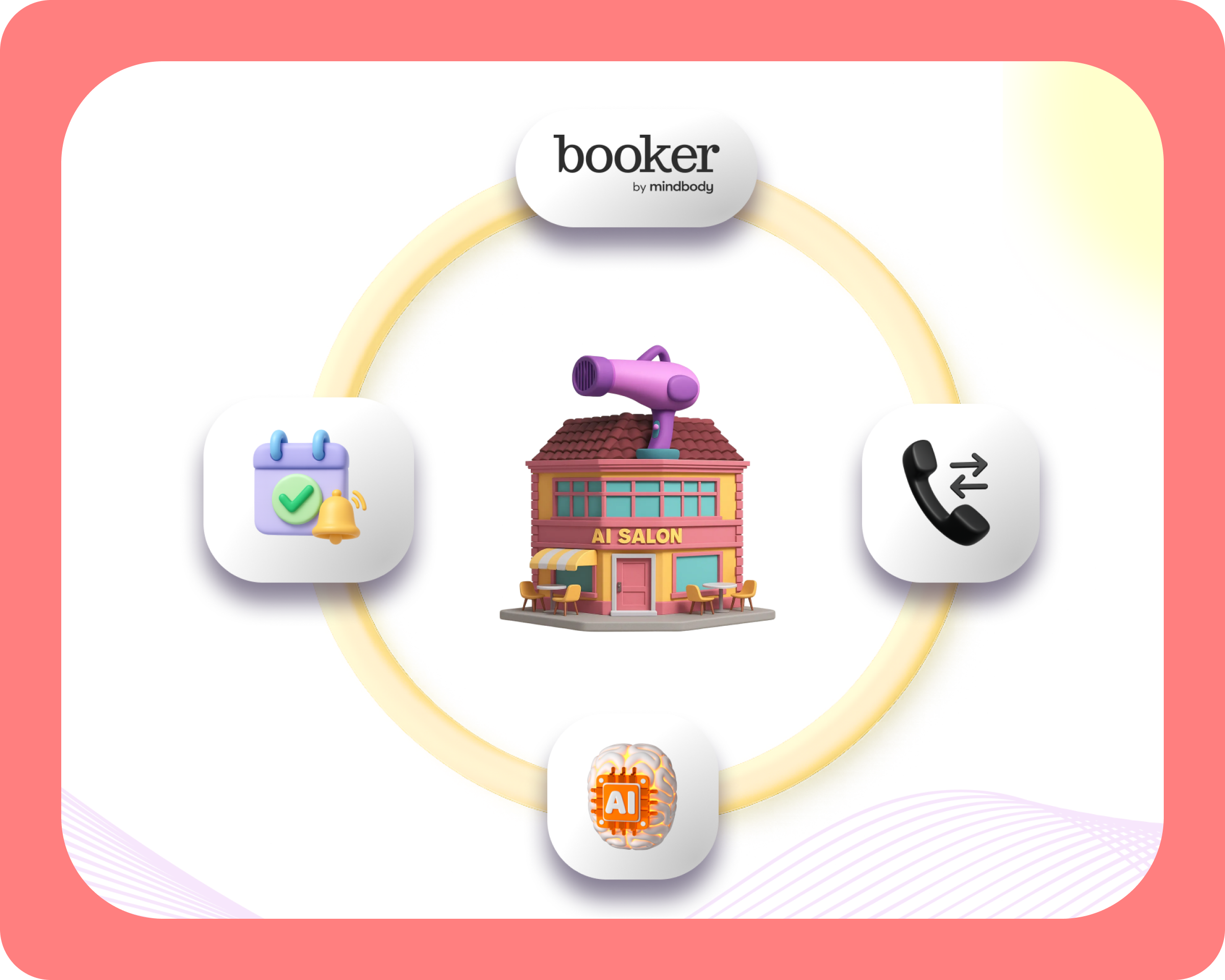

Latest Blogs
Best practice
September 2, 2026How Salons Generated $1M+ With One Move
Every salon owner is chasing growth. New ads. New offers. New retail shelf. New social posts at midnight. But the salons crossing seven figures didn’t do more. They fixed one…
Best practice
August 19, 2026AI Receptionist for Medical and Wellness: Complete Guide
An AI receptionist for medical and wellness practices is a 24/7 conversational voice and messaging tool that automates routine front-desk tasks like booking appointments, answering FAQs, and routing urgent calls.…
Best practice
July 11, 2026How To Train An AI receptionist On Your Salon’s Specific Services
Every salon runs differently. Your pricing, your stylists’ specialties, your cancellation rules none of that is “one size fits all.” So before you hand off your phone lines to automation,…