Step 1
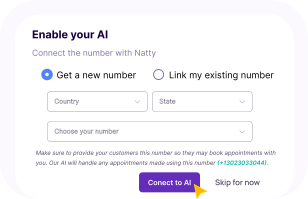
Connect your salon number
Link your salon number


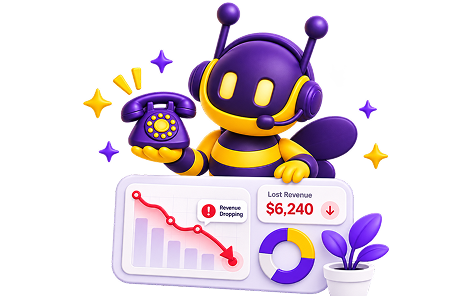
Salons lose up to 30% of incoming calls during peak hours, when every stylist is booked and no one can reach the phone. That's real revenue walking away, one ring at a time.

Intelligent voice interaction tailored entirely for high-end beauty salons and spas.
An AI receptionist for salons is a voice AI that answers your salon’s phone calls and handles conversations just like a trained front desk receptionist. Some salon owners know this as a virtual receptionist, a system that covers your phone line without a person physically staffing the desk.
Instead of sending callers through confusing menus or asking them to leave a voicemail, BookingBee AI understands what clients are saying, answers common questions, checks your real-time schedule, books appointments, confirms details, and can transfer calls to your team when human help is needed.
It’s more than a chatbot or basic IVR. BookingBee AI has an actual voice conversation with your clients and takes action during the call. Your front desk stays active and operational even when your shop is closed.
The operational reality that holds beauty professionals back from their true growth.
30%
Of peak hour salon calls are missed entirely
$50 — $150
Average lost service revenue per unanswered call
Roughly one in three calls during peak hours goes unanswered, and each missed call can represent $50 to $150 in lost service revenue depending on your average ticket. Multiply that across a busy Saturday and the number adds up fast.
Here’s the reality every salon owner already knows: your stylists are mid-service. Your front desk is juggling checkout, retail, and three walk-ins. The phone rings, and there’s genuinely no one who can pick it up without pulling someone away from a paying client. Clients don’t wait around either. Studies on hold-time abandonment show a large share of callers hang up after 30 to 45 seconds on hold, and most of them don’t call back. They call the next salon on the list.
Link your salon number
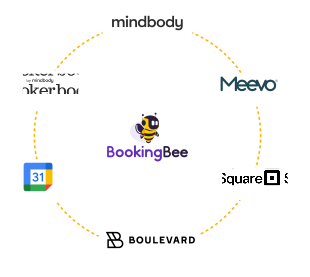
Like Meevo, Mindbody, Phorest, Square & more
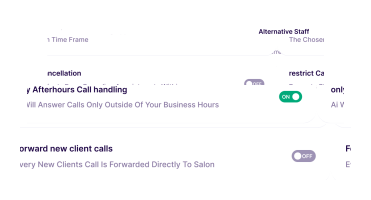
Customize when and how BookingBee speaks to your clients
Engineered with industry-specific intelligence to increase booking frequency and retention.

Clients talk to BookingBee the way they'd talk to a real receptionist. No robotic menus, no 'please hold.'

Every appointment syncs directly to your live calendar. Real-time scheduling means no double-bookings and no manual entry.

BookingBee speaks the languages your clients do, so no caller gets turned away over a language barrier.

If a client wants to speak with your team, the call transfers over immediately. Nothing falls through the cracks.

Clients get SMS confirmations and reminder calls automatically, cutting down on no-shows before they happen.

Every call is transcribed and logged as part of your CRM integration, so your team always has context without replaying voicemails.
BookingBee AI can integrate with salon booking systems and calendar platforms, including:
Unlocking higher service efficiency and modern client support standardizations.
Every call becomes an opportunity to book. By answering calls immediately and offering available appointment times, your salon can capture bookings that might otherwise be lost.
Your team doesn't need to answer every phone call personally. BookingBee AI responds to callers even when everyone is busy with clients.
Automated appointment confirmations and reminders help clients remember upcoming appointments and give them an opportunity to manage their booking.
Stop pulling stylists, managers, or front-desk staff away from their work every time the phone rings. Let your AI receptionist handle repetitive calls while your team focuses on clients.
Whether someone calls at 10 AM or 10 PM, they receive an immediate, consistent response with true 24/7 availability. Your salon stays available even when your team isn't.
How a premier Boca Raton destination modernized their checkout and phone operations.
Salon Sora’s front desk handled calls well during business hours, but once the doors closed at 7 PM, every call went straight to voicemail. Clients who worked corporate jobs, put kids to bed, or simply remembered late at night had no way to book.
Salon Sora connected BookingBee to their existing Meevo system and RingCentral call forwarding, so the AI receptionist took over the moment the front desk logged off. Setup required no technical work from their team.
BookingBee lets our clients book appointments anytime, even after hours, with every booking going straight into our calendar. Last month alone, 300+ after-hours calls created $6,000 in value. The team is fast, reliable, and highly responsive. BookingBee has been a game-changer for our salon’s operations and customer experience.
$6,246
in new revenue captured from after-hours calls that would have gone unanswered
$642
in revenue saved by preventing no-shows through automatic rescheduling and cancellations
342
After-hours calls captured in a month.
~0%
After-hours missed-call rate dropped from nearly 100% to almost zero

99
Per Month (billed annually)
Upto 8 staffs

299
Per outlet / Per Month (billed annually)
Upto 16 staffs

499
Per outlet / Per Month (billed annually)
Unlimited Staffs
We handle the configuration so you can remain focused on your salon clients.
See how BookingBee handles a real call for your salon's services.
Connect your calendar and booking platform, no dev work required.

BookingBee starts answering calls within days, not weeks.
Review call transcripts and booking data anytime from your dashboard.
Everything you need to understand regarding operations, calendars, and setup.
Schedule a call with our team to learn how BookingBee can transform your salon.
Talk to our teamAn AI receptionist for a salon is a voice-powered virtual assistant that automatically answers phone calls, texts, and chats. It uses natural language processing to converse with clients, check live staff calendars, book or reschedule appointments, and answer pricing questions 24/7, preventing missed calls while staff are busy.
Plans start at $99/month for salons with up to 8 staff, $299/month for up to 16 staff, and $499/month for unlimited staff with 24/7 phone support. Pricing is per outlet, and annual billing saves 20%. Multi-location salons can get custom pricing through our sales team.
Yes. BookingBee integrates directly with Meevo, Phorest, Mindbody, Boulevard, Booker, and Square. It reads your real, live availability and books straight into the same calendar your front desk already uses, so there's no separate system to manage or sync by hand.
Yes. A single front desk staff can only take one call at a time, which is exactly when bookings get lost. BookingBee answers and books multiple calls simultaneously, so no client ever hears a busy signal or gets sent to voicemail, even during your busiest peak hours or after closing.
BookingBee is upfront and natural in conversation, not designed to trick anyone. In practice, most clients care far more about getting booked quickly and accurately than about who or what answered. The experience feels like talking to a helpful, attentive front desk person who already knows your service menu.
Yes, on Elite plans. BookingBee supports multilingual conversations, so callers can book in the language they're most comfortable speaking. This matters most in diverse markets where language barriers on the phone often mean a lost client who simply can't get their questions answered and gives up.
For anything outside its scope, like a complex complaint or an unusual request, the call transfers smoothly to your team instead of leaving the client stuck. Nothing gets dropped, and every call is logged with a summary and transcript, so whoever picks it up has full context immediately.
The best option is one built specifically for salons, not a generic call-answering tool retrofitted for the industry. BookingBee is designed around real salon workflows, including peak-hour call volume, stylist-specific scheduling, and integrations with the booking platforms salons already use, like Meevo, Phorest, Mindbody, Booker and Square.
Look for real-time calendar syncing with your existing booking platform, natural conversation handling instead of a rigid phone menu, a smooth hand-off to your team for edge cases, and transparent, per-outlet pricing. Also confirm it can handle multiple simultaneous calls without making clients wait on hold.