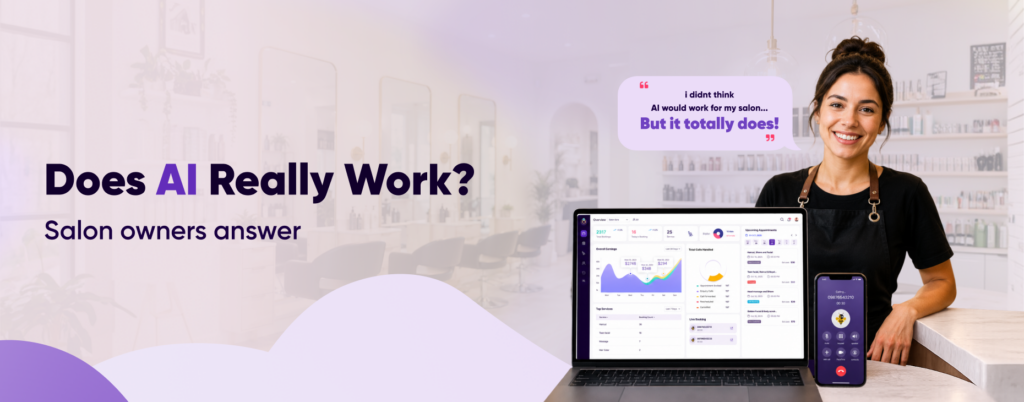
Yes. Many salon owners who have implemented AI receptionists report fewer missed calls, more after-hours bookings, and reduced front desk workload. The biggest surprise is often how quickly clients adapt to speaking with AI when it solves their problem efficiently.
If you’ve been searching for real experiences rather than generic AI explainers, you’re not alone. Most salon owners don’t want to know how the technology works. They want to know what happened when someone like them actually turned it on. This blog shares three real salon stories, patterns that emerged across all of them, and practical lessons to help you decide whether AI is the right fit for your salon.

Have salon owners actually seen results from AI receptionists?
Yes, and the results are measurable. Salons that have implemented AI receptionists consistently report higher booking capture rates, reduced missed calls, and less front desk pressure. The common thread across every story is not the technology itself it is the revenue that was already there, waiting to be answered.
The challenge is that most information about AI receptionists reads like a product brochure. It describes features, not outcomes. Salon owners want to know what changed in the first month, whether clients complained, and whether the numbers held up. That is what this blog covers.
What problems were salon owners trying to solve before adopting AI?
The most common trigger was not a technology decision it was a phone problem. Salons were losing bookings after hours, during peak service times when staff could not step away, and on weekends when nobody was available. Hiring additional front desk staff was either too expensive or impractical given the volume. Voicemail felt like a dead end, and clients simply moved on.
Staff burnout was also a recurring theme. Front desk teams were handling calls while checking clients in, managing walk-ins, and answering questions mid-treatment. Every interruption cost focus and sometimes cost a booking. Salon owners needed a way to absorb that overflow without stretching the team further.
What happened when Davey Dublin Salon added an AI receptionist?
The core problem at Davey Dublin was not poor service or low demand. It was availability. The salon was already using Phorest software for appointment management, which worked well during business hours. The gap existed outside those hours clients calling in the evening had no way to book, and those calls went unanswered.
The owner began exploring AI after recognizing that growth was being capped not by marketing or talent, but by when the phone got answered. What stood out about BookingBee’s AI receptionist was its focus on real salon workflows. Instead of acting like a voicemail replacement, it functioned as a conversational receptionist answering questions, checking availability, booking services, and syncing appointments directly into Phorest in real time.
The Phorest integration with Voice AI made adoption straightforward. From the client’s perspective, nothing changed except response speed. Calls were answered instantly, conversations felt natural, and bookings appeared directly inside Phorest without staff intervention.
What surprised the owner most was how quickly trust developed. Clients did not treat it like a machine. They treated it like a receptionist. Within the first few weeks, morning schedules were fuller because callers from the previous evening had already booked. Staff spent less time chasing voicemails. The after-hours window, which had previously been a gap, became a consistent source of confirmed appointments.
The lesson: integration matters more than automation. An AI that works inside your existing system creates accuracy and trust. An AI that sits on top of it creates friction.
Learn more about Davey Dublin’s success story in detail.
How did Salon Sora use AI with Meevo?
Salon Sora is a 30-plus stylist salon in Boca Raton, Florida. With a steady influx of phone inquiries every day, even after closing time, the team struggled to keep up with call volume. Clients called after hours, voicemail collected messages, but no one answered in real time. Clients often gave up and booked elsewhere.
Owner Ivette Suri recognized that even with an excellent team and a popular brand, the salon was leaking revenue simply because they could not answer every call. Salon Sora needed a solution that could answer phone calls like a real receptionist, understand natural language requests, schedule and reschedule appointments, sync instantly with Meevo software, and work around the clock without supervision or added staffing costs.
The Meevo integration with Voice AI linked directly to Salon Sora’s calendars and worked with their existing phone system via RingCentral call forwarding. It went live in days, not weeks, and required zero technical work from the in-salon team.
In just two weeks, 157 after-hours calls were handled automatically. Over $2,746 in new revenue was generated from previously missed opportunities, $642 was saved by preventing scheduling inefficiencies, and the salon achieved a 6.8x return on investment.
The lesson: after-hours is not a dead zone it is an untapped revenue window. For a salon with Salon Sora’s volume, closing that gap delivered a meaningful ROI in days, not quarters. Read more about Salon Sora’s success story.
What results did Salon D see after connecting AI to Mindbody?
Salon D is a high-traffic salon in Texas that already had strong operations, a loyal client base, and Mindbody software in place. The problem was quieter than most would notice: callers after hours reached voicemail, clients who wanted same-day or next-day appointments moved on to competitors, and the owner started noticing gaps in the schedule.
Salon D considered extending front desk hours and hiring remote receptionists, but both options came with higher payroll costs, scheduling complexity, and additional management overhead. Neither felt efficient for a problem that was ultimately about availability, not staffing.
With BookingBee’s Mindbody integration, the AI could check live availability, offer open slots, book appointments instantly, and update the schedule in real time. From the client’s perspective, the experience felt natural they called the salon, spoke to the AI voice agent, and booked just like they would with a human receptionist.
Within the first month, Salon D handled 458 after-hours calls, generated $5000+ in new bookings and achieved a 13.8x return on investment at a 16% conversion rate on calls.
The front desk team also noticed the difference during business hours. Fewer interruptions. Smoother client interactions. More focus on in-salon guests.
The lesson: phone calls remain a high-intent booking channel even when online booking exists. Clients who call want answers quickly, and they will not wait until tomorrow.
Learn more about Salon D’s success story.
Before AI vs After AI – For Salon Business
| What Matters | Before AI | After AI |
| Missed calls | Common after hours and during peak times | Answered 24/7 with instant response |
| Response times | Next-day callbacks at best | Real-time during and after hours |
| Booking capture | Limited to business hours only | Continuous, including evenings and weekends |
| Staff workload | Constant phone interruptions during treatments | Routine calls handled by AI, team focused on clients |
What surprised salon owners most after implementation?
The biggest surprise was client adoption. Owners expected pushback. Most got none. Clients cared more about being helped quickly than about who was helping them. If the question got answered and the booking got confirmed, the interaction was successful.
Call quality was another unexpected positive. The conversations did not feel robotic. Clients asked nuanced questions specific stylist requests, combo services, timing preferences and the AI handled them naturally. Staff who anticipated having to clean up AI mistakes found themselves with less to do, not more.
Onboarding was faster than expected. Salons were live within days in most cases, not weeks. And because the AI connected directly to their existing salon management software, there was no parallel system to maintain or learn. The biggest internal surprise was how quickly the front desk team came to rely on it.
What concerns did salon owners have before switching?
Practically every salon owner mentioned the same fears: the AI would sound robotic, it would make booking errors, clients would complain, or the integration would be unreliable. These are reasonable concerns and worth taking seriously before choosing a platform.
In the salons covered here, the most common concern was booking accuracy. Owners worried the AI would double-book appointments or misunderstand service requests. Integration with Phorest, Meevo, and Mindbody addressed this directly by giving the AI real-time access to availability rather than working from a static snapshot.
Client resistance was also flagged as a worry, but it rarely materialized. The experience of being answered quickly and booked instantly mattered more to clients than the novelty of who was answering. AI voice quality has improved significantly natural pacing, appropriate pauses, and the ability to handle rephrasing made conversations feel less like a phone tree and more like a quick front desk interaction.
What mistakes should salons avoid when implementing AI?
The most common failure mode is under investment in setup. Salons that configure the AI with minimal service information, no stylist profiles, and no testing against real call scenarios will see poor results. The AI performs as well as the information it is given.
Skipping a testing phase is another avoidable mistake. Running the AI on a secondary line or a limited time window before going fully live allows staff to catch edge cases unusual service requests, complex rescheduling scenarios, questions the AI should escalate rather than answer.
Unrealistic expectations also cause early disappointment. AI receptionists do not replace the need for thoughtful front desk management. They absorb overflow and handle routine volume. Salons that expect the AI to manage every possible client scenario without any configuration or monitoring will find gaps. Salons that treat it as a capable team member that needs onboarding will see better outcomes.
Finally, do not choose a generic AI answering tool for a salon context. Platforms built specifically for beauty businesses ones that understand service categories, stylist assignments, and booking workflows outperform general virtual receptionist products significantly.
Which salons benefit the most from AI receptionists?
Solo salons and owner-operators benefit enormously because the phone becomes a constant distraction when one person is managing both clients and the front desk. AI removes that conflict entirely.
Growing salons with increasing call volume but a lean team see the clearest ROI. Every new client who calls after hours or during a packed afternoon represents captured or lost revenue. As volume increases, so does the impact of having every call answered.
Multi-location businesses benefit from consistency. Clients at different locations receive the same quality of response regardless of staffing. Booking data is centralized. And the operational overhead of monitoring front desk performance across locations decreases when AI handles a significant share of routine interactions.
The honest answer is that almost any salon with meaningful phone volume benefits the question is degree. The higher the call volume, the more visible the impact.
Is an AI receptionist worth it for salons today?
For salons that receive regular phone inquiries, miss calls after hours, or have front desk teams stretched thin during peak times, the case is strong. The ROI timelines across Davey Dublin, Salon Sora, and Salon D were weeks, not months. The revenue came from bookings that already existed as intent it just was not being captured.
The clearest signal that AI makes sense: if you have ever ended a day knowing calls went unanswered, that is revenue with a known location. AI is what captures it.
What can salon owners learn from these AI receptionist stories?
The common thread across every story here is not the technology. It is the recognition that missed calls are not inevitable they are a solvable operational gap. Every salon featured here had good services, good clients, and real demand. What they lacked was availability.
The practical takeaways are consistent. After-hours is the highest-opportunity window. Integration with your existing booking software is non-negotiable for accuracy and adoption. Client resistance is almost always lower than expected. And results show up in the first month, not the first year.
If you are evaluating AI for your salon, the right questions are: how many calls do you miss after hours each week, what does each of those missed bookings cost you, and what would change if every call got answered?
Frequently Asked Questions
Most clients adapt quickly when the AI provides fast answers and accurate booking assistance.
Yes. AI can manage increased call volume without putting callers on hold or missing booking opportunities.
Most systems can transfer calls, take messages, or escalate requests to salon staff when needed.
Yes. Many AI receptionist platforms allow salons to personalize greetings, responses, and booking workflows.
No. Solo salon owners and small salons often benefit the most because AI helps manage calls without hiring additional staff.
 BookingBee lets our clients book appointments anytime, even after hours, with every booking going straight into our calendar. Last month alone, 300+ after-hours calls created $6,000 in value. The team is fast, reliable, and highly responsive. BookingBee has been a game-changer for our salon’s operations and customer experience.

Your After-Hours Calls Are Revenue Left Behind
BookingBee's AI receptionist captures every booking when your team isn't there - no extra staff, no missed opportunities.
Book A DemoRelated Posts
How To Train An AI receptionist On Your Salon’s Specific Services

After-Hours Salon Booking: How to Capture Every Late-Night Call
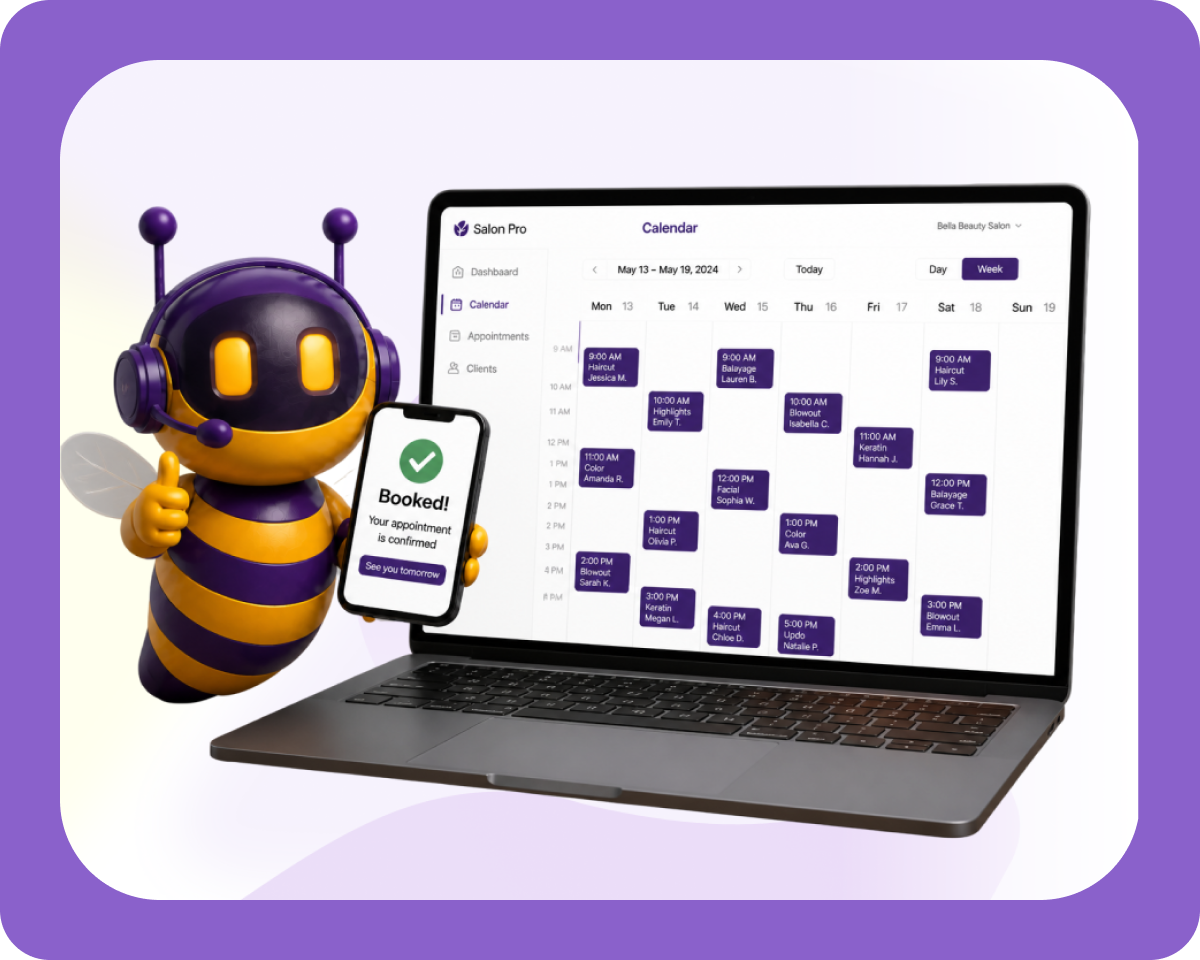
How to Fill Your Salon’s Calendar: Waitlists, Cancellation Recovery
How to Increase Salon Revenue: 10 Strategies That Actually Work in 2026
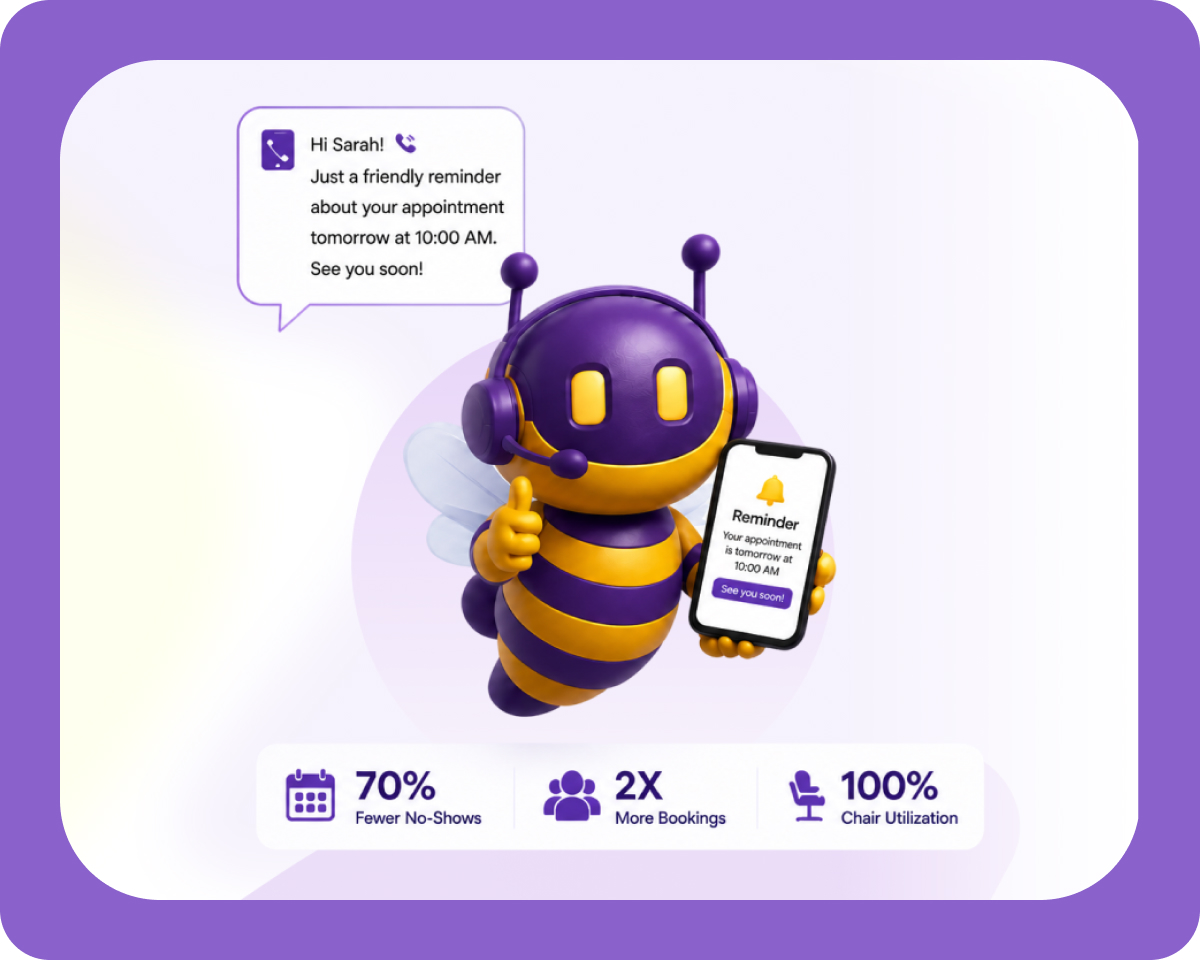
How to Reduce No-Shows at Your Salon: The Complete 2026 Playbook
Latest Blogs
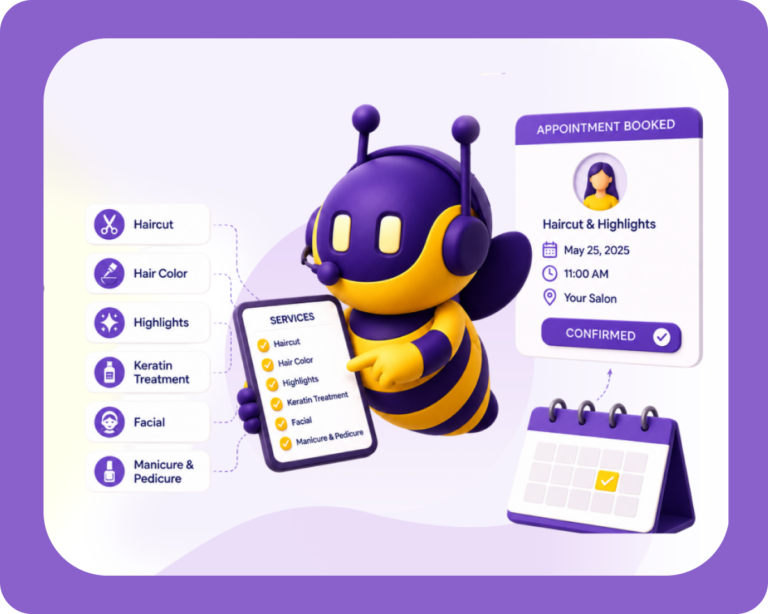
Best practice
July 11, 2026How To Train An AI receptionist On Your Salon’s Specific Services
Every salon runs differently. Your pricing, your stylists’ specialties, your cancellation rules none of that is “one size fits all.” So before you hand off your phone lines to automation,…
Best practice
July 9, 2026After-Hours Salon Booking: How to Capture Every Late-Night Call
Your salon closes at 7 PM, but your clients don’t stop thinking about their next appointment when the lights go off. A working mom remembers she needs a haircut at…
Best practice
July 9, 2026How to Fill Your Salon’s Calendar: Waitlists, Cancellation Recovery
A fully booked calendar and a “pretty good” calendar look almost identical from the outside. The difference shows up at the end of the month in the gaps nobody noticed…